

Key takeaway: AI integration is now essential for small travel agencies to remain competitive in 2026. By automating workflows and itinerary generation, firms can boost conversion rates by 30% for less than $100 monthly. This technology ensures 24/7 responsiveness and smart lead qualification, allowing human agents to focus on high-value emotional connections and complex luxury travel planning.
Nearly 43% of high-income millennials now use generative AI to plan their trips, signaling a massive shift in how travel is discovered and booked. This rapid adoption proves that staying competitive is no longer just about personal touch, but about the speed of your digital response.
Small agencies often struggle to keep up with the instant gratification expected by modern travelers while managing heavy back-office workloads. We will explore how smart automation tools allow boutique firms to scale their operations and deliver personalized itineraries in minutes without losing their human soul.
- Why AI Small Travel Agency Tools Are a Necessity in 2026
- 3 Core Workflows Where Automation Beats Manual Travel Planning
- How to Maintain the Human-AI Balance for Premium Clients?
- A 60-Day Roadmap for Agency-Scale Adoption
Why AI Small Travel Agency Tools Are a Necessity in 2026
AI integration boosts small agency conversion by 30% through instant itinerary generation and 24/7 lead qualification. Modern SaaS tools cost under $100 monthly, replacing hours of manual data entry with automated workflows. This shift toward efficiency ensures boutique firms remain relevant against industry giants.
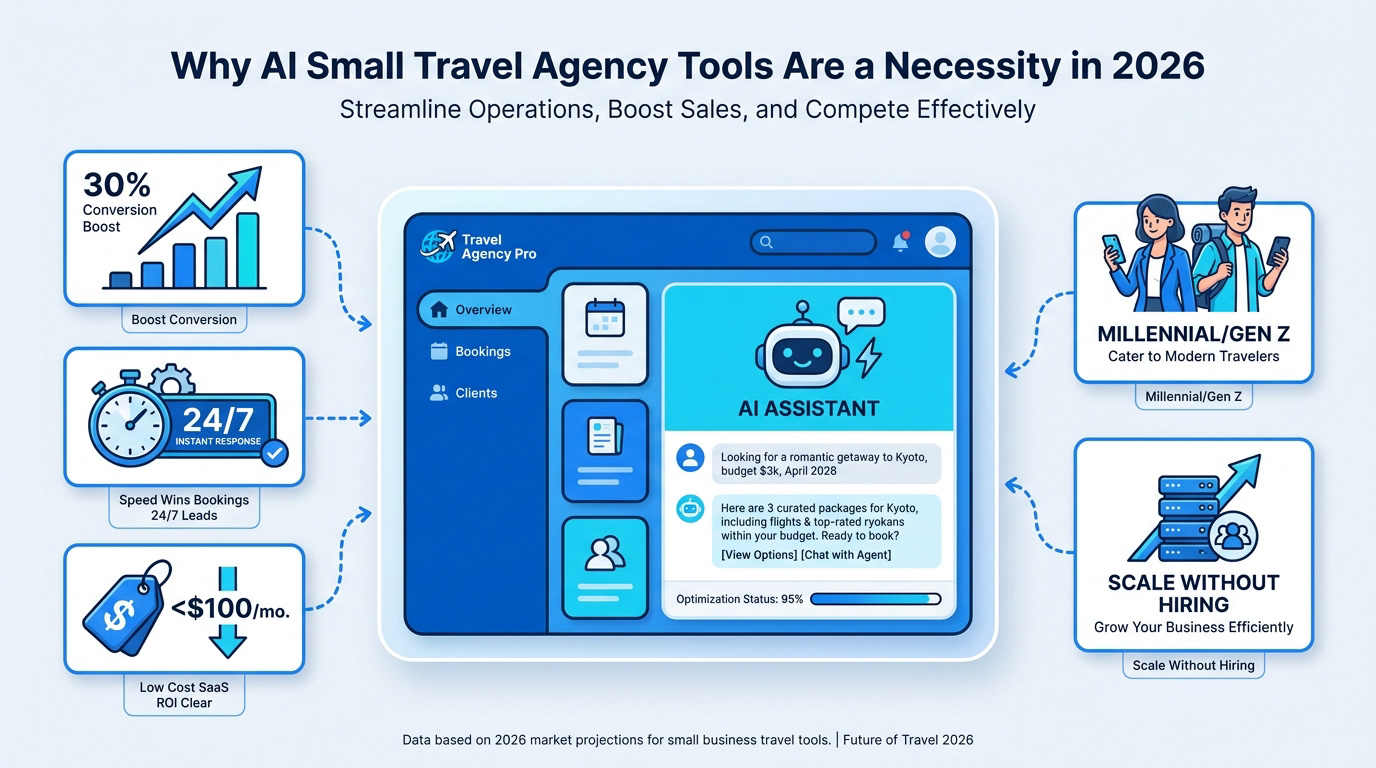
The mention of conversion leads directly into the discussion of response speed as a competitive currency.
Speed as the New Currency for Modern Booking Conversion
Response time directly dictates booking success today. Modern travelers expect answers within minutes, not days. Delayed replies often result in lost leads to faster competitors. Speed is now the primary differentiator for boutique firms in a crowded market.
Millennial and Gen Z preferences drive this change. These groups value instant gratification during the discovery phase. They prefer agencies that offer immediate digital interaction over traditional, slow email exchanges that feel outdated.
AI effectively bridges this gap. Automated replies ensure no lead goes cold while agents handle complex tasks. How Small Travel Agencies Are Using AI to Stay Competitive starts with capturing interest the second it happens.
Breaking the Myth of High Costs for Independent Agencies
Forget the idea that AI is only for giants. Subscription-based models make advanced tools accessible. Small firms can now access enterprise-grade automation for a low monthly fee, often starting around $99 per month.
Compare manual labor costs to software pricing. One automation tool often costs less than two hours of an agent’s time. The ROI becomes clear when calculating saved administrative hours and reduced errors in booking confirmations.
Automation significantly reduces overhead. It minimizes the need for extra seasonal staff during peak periods. It allows boutique agencies to scale their operations without increasing their fixed monthly headcount or sacrificing service quality.
3 Core Workflows Where Automation Beats Manual Travel Planning
While cost is a factor, the real magic happens when you look at the specific daily tasks where algorithms simply outpace human fingers.
Drafting Personalized Itineraries in Minutes
Prompt engineering creates custom schedules instantly. You define budget, pace, and niche interests. AI builds a solid baseline in seconds. This lets agents focus on creative polish.
Adventure travel segments benefit from specific prompts. Include gear needs or trail difficulty levels. Tools pull from vast databases for unique, off-the-beaten-path spots.
Corporate efficiency improves significantly. Automation manages tight flight connections. It ensures hotel proximity to meeting venues with high precision.
Smart Lead Qualification and 24/7 Enquiry Management
Lead scoring systems change the game. AI analyzes incoming enquiries to rank booking probability. Agents call the most promising prospects first every morning.
Automated nurturing sequences maintain engagement. Send personalized follow-ups based on destination interests. Keep the agency top-of-mind without manual staff intervention.
Responsiveness stays active 24/7. Chatbots handle basic questions during holidays or nights. Potential clients receive immediate attention regardless of time zones or office hours.
Handling Back-Office Tasks and Supplier Document Generation
Invoice reconciliation becomes effortless. Automation matches supplier bills with internal records instantly. It flags discrepancies to prevent overpayment or missed commissions.
Visa requirement alerts prevent travel disasters. Systems scan passports and destination rules to flag issues. This reduces human error in complex international documentation significantly.
Payment tracking ensures financial stability. Automated reminders help clients pay balances on time. This stabilizes cash flow and reduces uncomfortable collection calls.
How to Maintain the Human-AI Balance for Premium Clients?
Efficiency is great, but luxury travel still relies on the soul of a real expert, making the balance between code and charisma vital.
Using Technology to Support Rather Than Replace Travel Agents
Distinguish between high-touch and low-touch bookings. Routine flights are perfect for automation. Complex, multi-generational luxury trips require human empathy and intuition. Use tech for the logistics and humans for the emotional connection.
Emphasize the agent’s role as a curator. AI provides the raw options. The agent selects the one that fits the client’s unique personality.
Tech handles the data. Humans handle the delight and surprise.
Fact-Checking AI Outputs to Prevent Itinerary Hallucinations
Provide methods for verifying data. Always cross-reference AI-generated hotel availability with live booking engines. Never trust an AI flight price without a final manual check.
Prevent costly errors in safety alerts. AI might miss recent geopolitical changes or local strikes. Agents must verify safety advice through official government travel portals.
Implement a “human-in-the-loop” protocol. Every document must be scanned by an expert before reaching the client’s inbox.
Dynamic Pricing Strategies for Competitive Market Positioning
Analyze real-time demand models. AI tracks market fluctuations to suggest the best booking windows. This helps small agencies offer prices that compete with major online retailers.
Identify upsell opportunities. Historical data analysis reveals which clients prefer room upgrades or private tours. Target these offers precisely to increase the average booking value.
Use data to personalize the offer. Tailor the price and package based on the client’s demonstrated loyalty and spending habits.
A 60-Day Roadmap for Agency-Scale Adoption
Knowing what AI can do is one thing, but deploying it without breaking your current workflow requires a disciplined timeline.
Moving From Pilot Experiments to Full Production Operations
Propose a testing framework first. Start with one specific task, like email drafting, for thirty days. Measure the time saved per agent. Compare these results against the software cost to determine the actual ROI.
Select tools based on agency niche. A corporate firm needs different automation than a honeymoon specialist. Focus on tools that integrate with your existing CRM system.
Scale gradually to other departments. Once the pilot succeeds, roll out automation to the back-office and marketing teams.
Managing Team Training and Data Security Protocols
Cover data privacy protocols immediately. Ensure your AI tools are GDPR or CCPA compliant. Never input sensitive client credit card details into public AI models or unencrypted chats.
Manage change management with empathy. Staff may fear job replacement. Explain that AI handles the boring tasks so they can focus on the rewarding parts of travel planning.
Invest in ongoing training sessions. Technology evolves every month. Schedule short, regular sessions to share the best prompts and new features discovered by the team members.
AI transforms small agencies by accelerating itinerary creation and automating lead qualification for 24/7 responsiveness. Integrating these tools now ensures you capture high-value prospects while reducing overhead costs. Adopt these automated workflows today to deliver the hyper-personalized experiences that modern travelers demand and secure your firm’s future.
FAQ
How exactly are boutique travel agencies using AI to stay ahead of the curve?
Small agencies are leveraging AI primarily to bridge the gap in operational speed and personalization. By integrating generative AI, these firms can now produce complex, customized itineraries in minutes, a task that previously took hours of manual research. This rapid response is vital for modern conversion, as data shows that 43% of high-income millennials already use AI to plan their trips and expect near-instant digital interaction.
Beyond planning, AI helps independent agencies compete by automating back-office workflows like invoice reconciliation, visa requirement checks, and lead qualification. By using AI to score leads based on booking probability and revenue potential, boutique firms ensure their human experts focus only on the most promising prospects, effectively scaling their operations without increasing headcount.
Is AI technology affordable for independent travel consultants and small firms?
Yes, the myth that AI is reserved for industry giants is officially debunked. There is a wide range of accessible tools with subscription-based models starting under $10 monthly. For instance, tools like TripPlanner AI offer Pro plans for as little as $7.99 per month, while platforms like Layla or Pilot provide premium features for about $10 per month. There are even highly capable free options such as GuideGeek and Wonderplan.
For agencies seeking more robust integration, specialized assistants like Ringover’s AI start at approximately €99 per month. When compared to the cost of manual labor, these tools often pay for themselves by replacing just two hours of an agent’s administrative time, offering a clear and immediate ROI for small businesses.
How does AI lead scoring work for travel agencies compared to traditional methods?
Traditional lead scoring relies on static, manual rules that often lead to missed opportunities or human bias. In contrast, AI-based lead scoring uses machine learning to analyze fragmented data from CRMs, web behavior, and historical bookings. It identifies subtle patterns, such as search frequency, date flexibility, and engagement with specific luxury content, to predict the actual intent and revenue potential of a traveler.
This allows for dynamic routing: high-value “hot” leads are instantly sent to senior agents, while mid-range leads are nurtured through automated email sequences. This ensures that no lead goes cold and that the agency’s resources are always allocated to the bookings most likely to maximize margins.
Can AI really generate accurate travel itineraries without human help?
AI is an incredible engine for generating baselines and creative ideas, but it is not a complete replacement for human expertise. While it can draft a personalized schedule in seconds based on specific prompts, including budget, pace, and niche interests, it is prone to “hallucinations” or outdated information regarding flight prices and local safety alerts.
The most successful agencies use a “human-in-the-loop” protocol. The AI handles the data-heavy logistics and initial drafting, but a professional agent must perform a final check to verify hotel availability and safety advice through official portals. This balance ensures the efficiency of automation while maintaining the high-touch, reliable service that premium clients demand.
What is the best way for a small agency to start implementing AI?
The recommended approach is a 60-day roadmap starting with pilot experiments. Agencies should begin by automating one specific, time-consuming task, such as drafting destination content or initial enquiry management, for 30 days. This allows the team to measure time savings and ROI before scaling to other departments like marketing or back-office operations.
During this transition, it is crucial to focus on data security, ensuring all tools are GDPR or CCPA compliant. Training is equally important; regular sessions to share effective prompts and new features help staff view AI as a supportive tool that handles “boring” tasks, allowing them to focus on the rewarding, creative aspects of travel planning.
FAQ
How exactly are boutique travel agencies using AI to stay ahead of the curve?
Small agencies are leveraging AI primarily to bridge the gap in operational speed and personalization. By integrating generative AI, these firms can now produce complex, customized itineraries in minutes, a task that previously took hours of manual research. This rapid response is vital for modern conversion, as data shows that 43% of high-income millennials already use AI to plan their trips and expect near-instant digital interaction.
Beyond planning, AI helps independent agencies compete by automating back-office workflows like invoice reconciliation, visa requirement checks, and lead qualification. By using AI to score leads based on booking probability and revenue potential, boutique firms ensure their human experts focus only on the most promising prospects, effectively scaling their operations without increasing headcount.
Is AI technology affordable for independent travel consultants and small firms?
Yes, the myth that AI is reserved for industry giants is officially debunked. There is a wide range of accessible tools with subscription-based models starting under $10 monthly. For instance, tools like TripPlanner AI offer Pro plans for as little as $7.99 per month, while platforms like Layla or Pilot provide premium features for about $10 per month. There are even highly capable free options such as GuideGeek and Wonderplan.
For agencies seeking more robust integration, specialized assistants like Ringover’s AI start at approximately €99 per month. When compared to the cost of manual labor, these tools often pay for themselves by replacing just two hours of an agent’s administrative time, offering a clear and immediate ROI for small businesses.
How does AI lead scoring work for travel agencies compared to traditional methods?
Traditional lead scoring relies on static, manual rules that often lead to missed opportunities or human bias. In contrast, AI-based lead scoring uses machine learning to analyze fragmented data from CRMs, web behavior, and historical bookings. It identifies subtle patterns, such as search frequency, date flexibility, and engagement with specific luxury content, to predict the actual intent and revenue potential of a traveler.
This allows for dynamic routing: high-value “hot” leads are instantly sent to senior agents, while mid-range leads are nurtured through automated email sequences. This ensures that no lead goes cold and that the agency’s resources are always allocated to the bookings most likely to maximize margins.
Can AI really generate accurate travel itineraries without human help?
AI is an incredible engine for generating baselines and creative ideas, but it is not a complete replacement for human expertise. While it can draft a personalized schedule in seconds based on specific prompts, including budget, pace, and niche interests, it is prone to “hallucinations” or outdated information regarding flight prices and local safety alerts.
The most successful agencies use a “human-in-the-loop” protocol. The AI handles the data-heavy logistics and initial drafting, but a professional agent must perform a final check to verify hotel availability and safety advice through official portals. This balance ensures the efficiency of automation while maintaining the high-touch, reliable service that premium clients demand.
What is the best way for a small agency to start implementing AI?
The recommended approach is a 60-day roadmap starting with pilot experiments. Agencies should begin by automating one specific, time-consuming task, such as drafting destination content or initial enquiry management, for 30 days. This allows the team to measure time savings and ROI before scaling to other departments like marketing or back-office operations.
During this transition, it is crucial to focus on data security, ensuring all tools are GDPR or CCPA compliant. Training is equally important; regular sessions to share effective prompts and new features help staff view AI as a supportive tool that handles “boring” tasks, allowing them to focus on the rewarding, creative aspects of travel planning.